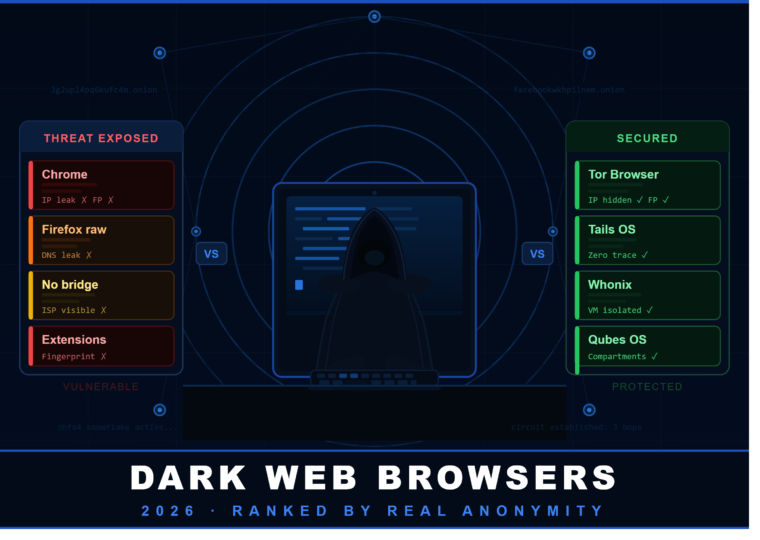
Most guides tell you which dark web browser is best. But they never tell you that picking the wrong one for your situation can actually put you at more risk than using no special browser at all.
The real question is not which browser has the most features. It is who might be watching you, what they can see, and what happens if they find you. That answer decides which tool you need. This guide walks you through that decision step by step.
Verified Carding Markets for Cashouts
Verified accounts, real logs, and secure transfers - browse the categories most buyers trust on clear and darkweb.

Quick Answer: Which Tool Do You Need?
- You want basic privacy from ads and trackers: Use Mullvad Browser or Brave with Tor turned on
- You are a journalist or researcher: Use Tor Browser set to Safest mode, no add-ons
- You need zero trace on a shared computer: Use Tails OS from a USB drive
- You need long-term anonymous work sessions: Use Whonix with two virtual machines
- You face government-level threats: Use Qubes OS combined with Whonix
- You are on Android: Use Orbot plus Tor Browser, with bridges turned on
- You are on an iPhone: Use Onion Browser, approved by the Tor Project
No matter which tool you pick: do not resize the browser window, do not install add-ons in Tor Browser, and do not open downloaded files while you are still connected.
What a Dark Web Browser Actually Does and Does Not Do
A dark web browser is a tool that sends your internet traffic through a special network so websites cannot see who you are or where you are. The most common network used for this is Tor. The most well-known sites on the dark web use addresses ending in .onion, which only works inside the Tor network.
Related: Top 10 Dark Web Browsers for Secure Tor Browsing
People mix up two things a lot. The deep web is simply any part of the internet that search engines like Google do not show in results. Your email inbox, your online banking, private company databases, and content behind a paywall. All of that is the deep web. It is huge, mostly boring, and you use it every day without thinking about it.

The dark web is a much smaller part of the internet that is built specifically for privacy. You need special software to reach it. It has both legal and useful things on it, such as secure email services, tools for journalists, and news sites for people living under strict governments. It also has illegal content. The browser you use to get there is just a tool. What you do once you are there is what matters legally.
Here is what a dark web browser does not do. A browser can not protect you against viruses or malware in downloaded files. Does not verify that a website is telling the truth. It doesn’t prevent you from making mistakes. Most people who get exposed do so because of something they did, not because the browser failed.
Who Are You Hiding From? Answer This Before You Pick a Tool
This is the question almost every other guide skips. A company that tracks your shopping habits online is very different from a government spy agency. You do not need the same tools to protect yourself from both. Using the most extreme setup when you only need basic privacy creates problems of its own, because complicated tools are easier to use incorrectly.
Find yourself in the table below before you read the tool reviews.
Read also: Best Non VBV Cardable Sites List: 100% Working & Verified
Know your risk level before picking a tool
| Level | Who You Are | Who May Be Watching | Best Tool | Mistake to Avoid |
|---|---|---|---|---|
| Level 1 | Everyday privacy user | Ad companies, data brokers | Mullvad Browser or Brave with Tor | Logging into personal accounts |
| Level 2 | Journalist, student, researcher | Your internet provider, your employer | Tor Browser on the safest setting | Installing add-ons, resizing the window |
| Level 3 | Activist, whistleblower | A company or private investigator | Tails OS on USB plus offline comms | Reusing the same device |
| Level 4 | Human rights worker, person in danger | Your government | Whonix on a clean device | Changing network settings inside Whonix |
| Level 5 | High-value target | Intelligence agencies | Qubes OS with Whonix, single-use sessions | Mixing real identity with anonymous one |
← Swipe to see all columns
Most people reading this are at Level 1 or Level 2. Very few people face Level 5 threats. Knowing your level stops you from using tools that are far more complex than you need, which often leads to mistakes that break your privacy faster than a simpler tool used correctly.
All Dark Web Browsers Compared Side by Side
| Browser | How It Works | Privacy | Difficulty | Best For | Updated |
|---|---|---|---|---|---|
| Tor Browser | Traffic through 3 volunteer servers | ★★★★★ | Medium | Private browsing, .onion sites | ✓ Yes |
| Mullvad Browser | Makes all users look identical online | ★★★★☆ | Easy | Private browsing with a VPN | ✓ Yes |
| Tails OS | Full OS that runs from a USB drive | ★★★★★ | Medium | Leaving no trace on any computer | ✓ Yes |
| Whonix | Two virtual machines, work and internet separate | ★★★★★ | Hard | Long anonymous work sessions | ✓ Yes |
| Qubes OS + Whonix | Every task in its own isolated container | ★★★★★ | Expert | Against government-level threats | ✓ Yes |
| I2P | A private network inside the internet | ★★★★☆ | Hard | Private communities and messaging | ✓ Yes |
| Freenet | Files spread across thousands of computers | ★★★★☆ | Medium | Publishing content that cannot be deleted | ✓ Yes |
| Brave with Tor | Regular browser with Tor as an option | ★★★☆☆ | Very Easy | Quick visits to .onion sites | ✓ Yes |
| Onion Browser (iPhone) | Tor browser made for iPhones | ★★★☆☆ | Easy | iPhone users who need Tor | ✓ Yes |
| Orbot + Tor (Android) | Tor covering the whole phone, not just browser | ★★★★☆ | Medium | Android, especially where Tor is blocked | ✓ Yes |
| Subgraph OS | OS with Tor built in | ★★★★☆ | Hard | Do not use. No longer updated. | ✗ No |
← Swipe to see all columns on small screens
Each Browser Explained Clearly
Tor Browser: The One Most People Should Start With
Tor Browser is the most widely used tool for private browsing and dark web access. It has been around since 2008 and is still the go-to choice for most people. The reason it works so well is not because it is fancy. It is because it has been tested by millions of people over many years, and it still does its job.
Read also: How to Disable Automatic Updates in Windows: A Step-by-Step Guide
When you use Tor, your internet traffic passes through three computers run by volunteers around the world. Each computer only knows one small piece of the puzzle. The first computer knows where you started, but not where you are going. The last computer knows where you are going, but not where you started. No single computer knows both. That is what keeps you private.
What Tor stops: your internet provider seeing what sites you visit, websites knowing your real location, and the most common tracking methods. What Tor does not stop: someone who can watch your internet traffic at the very start and end of its journey at the same time. That kind of attack takes huge resources and is only done by major government agencies against specific targets. For almost everyone reading this, it is not a realistic concern.
How to Set Up Tor Browser Correctly
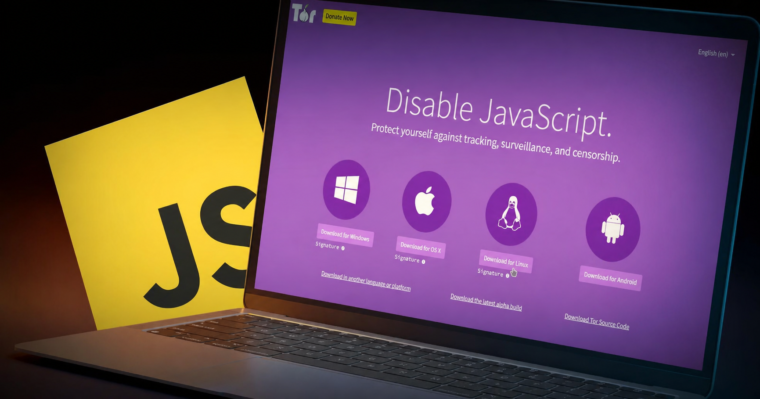
Click the shield icon next to the address bar and choose Advanced Security Settings. Set the level to Safest. This turns off JavaScript on all sites and blocks many things that could reveal who you are. It is the one setting that matters most.
- Do not resize the browser window. Tor makes all users look the same size. If you resize it, your real screen size becomes visible and sets you apart from other users.
- Do not install add-ons or extensions. Every add-on you install makes your browser look different from everyone else using Tor. That difference can identify you.
- Do not log into accounts linked to your real name while using Tor. The moment you do, the website knows who you are, no matter what browser you use.
- Before you do anything sensitive, go to
check.torproject.orgto confirm Tor is actually working. - Click New Identity in the Tor menu when switching between different tasks to get a fresh connection.
Bridges and Bypass Tools: For People Where Tor Is Blocked
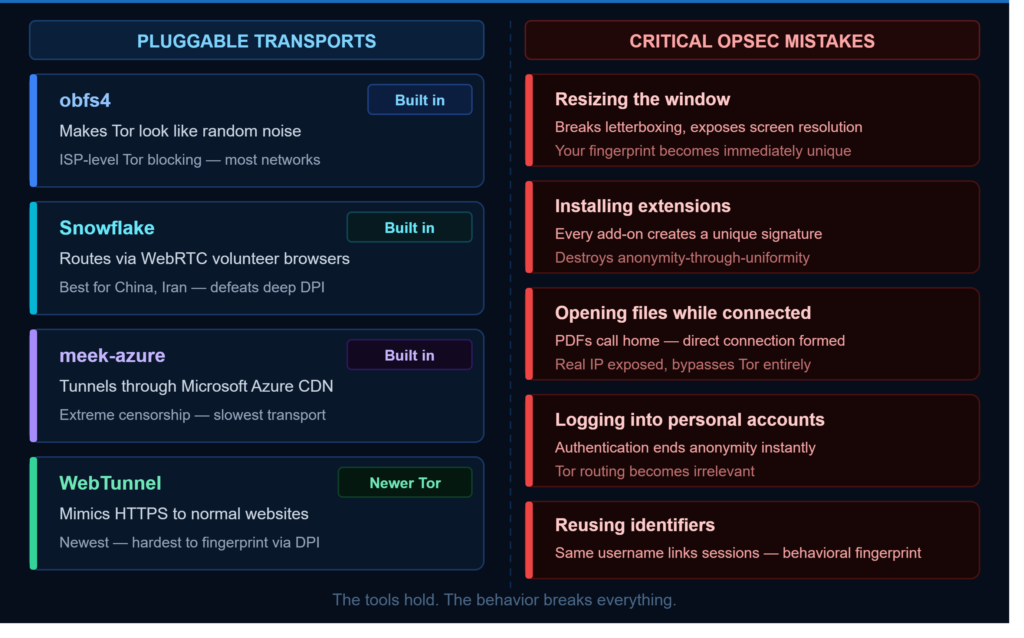
In some countries, the government blocks Tor so people cannot use it. China, Russia, Iran, and Belarus are examples. If you try to connect to Tor normally in those places, it fails. Bridges solve this problem. A bridge is just a Tor entry point that is not listed publicly. Because it is not on any public list, the government cannot block it by looking up the list.
But even bridges are sometimes not enough. Some governments use technology that can identify Tor traffic just by how it looks, even without knowing the address. The tools below disguise your Tor traffic so it looks like something else entirely.
| Tool | What It Does | When to Use It | Where to Find It |
|---|---|---|---|
| obfs4 | Makes Tor traffic look like random data | Most countries that block Tor | Built into Tor Browser |
| Snowflake | Sends traffic through volunteer browsers via video call tech | China, Iran, deep traffic inspection | Built into Tor Browser |
| meek‑azure | Hides Tor inside normal Microsoft server traffic | Countries with the strictest blocking | Built into Tor Browser |
| WebTunnel | Makes Tor look like a normal website visit | Networks blocking known Tor patterns | Newer Tor versions |
| Bridges | Unlisted entry points that are harder to block | When your provider blocks main Tor servers | bridges.torproject.org |
← Swipe to see all columns on small screens
To get bridges, visit bridges.torproject.org in any browser or send an email from a Gmail or Riseup address. You will get a list of bridge addresses to paste into Tor Browser before you connect.
Mullvad Browser: Private Browsing Without Tor’s Slower Speed
Mullvad Browser was created in 2023 by the team behind Mullvad VPN, together with the people who make Tor. The goal was simple: give people the same level of protection against tracking that Tor Browser provides, but without the slower connection speed that comes with routing through Tor.
It does this by making every single user look the same to any website trying to track them. Your screen size, your graphics card output, your audio settings, and your fonts. All of these look identical across all Mullvad Browser users. If a website tries to build a profile of you based on your browser’s characteristics, it gets back the same result it gets for every other Mullvad Browser user. You blend into the crowd.
Read also: How to Set Up Proxy Server Configurations: Enterprise & OS Guide
This browser works best when you pair it with a VPN that does not keep logs. Without a VPN, the site still sees your real IP address, just not much else. And one more thing: do not change any settings, install any add-ons, or change the look of the browser. Every change you make separates you from the crowd and starts to make you identifiable again.
Tails OS: When You Need to Leave No Trace Behind
Tails is not a browser. It is a full operating system, like Windows or Mac, but designed purely for privacy. You put it on a USB drive and plug it into any computer. The computer then runs Tails instead of its normal system. When you are done and you unplug the USB, Tails is completely gone. No history, no files, no record that Tails was ever on that machine.
It works this way because Tails runs entirely in the computer’s short-term memory, called RAM. RAM is automatically cleared when you turn off a computer. Tails never writes anything to the hard drive. So even if someone takes the computer afterward and examines it carefully, there is nothing to find.
Journalists who meet with sources, activists in dangerous countries, and researchers working with sensitive material. These are the people Tails is built for.
Important Steps Before You Use Tails
- Check the file before you install it. Tails provides a digital signature for every download so you can confirm the file has not been tampered with. Do this before putting it on a USB drive.
- Use the official Tails installer or BalenaEtcher to create the USB drive. Regular disk-writing tools may not create it correctly.
- Always shut down completely. Never just close the lid. Closing the lid puts the computer to sleep, and the memory is not cleared. A full shutdown clears everything.
- If you save files inside Tails using the Persistent Storage feature, protect them with a strong password. That password is the only thing protecting those files if your USB drive is taken.
Whonix: A Setup Where Your Real Location Cannot Leak, Even If You Are Hacked
Whonix takes a different approach from every other tool on this list. Instead of just hiding your traffic, it changes the actual structure of how your computer connects to the internet so that your real location literally cannot be revealed, even if a hacker takes full control of your browser.
It does this by running two separate virtual machines, which are basically two computers running inside your real computer at the same time. One virtual machine handles all internet connections and sends everything through Tor. The other is where you actually do your work. These two machines are cut off from each other. Your work machine has no direct connection to the internet at all. It has to go through the first machine, which only knows how to use Tor.
So if a malicious website installs something harmful on your work machine and that harmful software tries to phone home to reveal your location, it cannot. It does not have access to your real internet connection. The most it can reach is the Tor network, which does not reveal your location either.
- Never change the network settings inside the first machine. They are set up carefully on purpose. Changing them can break the protection without you knowing.
- Keep both machines updated at the same time. If one is old and one is new, the outdated one becomes a weak point.
- Save a clean copy of both machines right after you first set them up. If something goes wrong later, you can go back to that clean copy.
- Always shut down both machines when you are done. Leaving one running can cause problems.
Qubes OS with Whonix: The Highest Level of Protection Available to Civilians
Qubes OS is an operating system built around one core idea: keep everything separate. Every single task you do runs in its own isolated container, called a “qube.” Your work emails, your private browsing, the files you download, the apps you use. Each one lives in its own sealed-off space. If one container gets infected with something harmful, it stays contained there and cannot reach your other containers.
When you add Whonix into Qubes, you combine that total separation with the network protection Whonix provides. It is the most complete privacy setup that a regular person can actually run on a personal computer.
- Set up a Whonix browsing template with Tor Browser already installed and configured the way you want it.
- When you want to browse, launch a single-use container based on that template. It is a fresh copy each time you open it.
- When you close the container, everything inside it is permanently deleted. No cookies, no history, no files left behind.
- Keep your real-name activities and your anonymous activities in completely separate containers. Never move anything between them unless necessary.
- Never use the main control system of Qubes for browsing. It is the master system that controls everything else. If it gets compromised, the whole setup fails.
I2P: A Private Internet Inside the Internet
I2P is not a replacement for Tor. It is something different entirely. While Tor is mainly used to browse the regular internet privately, I2P creates its own small private internet that exists only for I2P users. Forums, file sharing, chat, websites. All of it stays inside I2P and never touches the regular internet.
The way it handles traffic is also different. Instead of a fixed path through three servers like Tor uses, I2P bundles multiple messages together and sends them through many different paths. This makes it harder for anyone watching the network to figure out where traffic is coming from or going to.
I2P is best for people who want to be part of a private community or messaging network that has no connection to the outside internet. If your goal is to browse regular websites or visit .onion sites, Tor is still the better choice. Update I2P regularly. And do not try to use I2P to reach the regular internet. That defeats the whole point.
Freenet: For Publishing Content That Cannot Be Taken Down
Freenet has been running since the year 2000. It was built to solve one specific problem: how can someone publish information that cannot be traced back to them and cannot be removed by anyone?
The answer Freenet uses is to split every file into small encrypted pieces and spread those pieces across hundreds of volunteer computers. No one computer has the whole file. If someone tries to delete the content, they can only remove it from one place. As long as enough volunteers share pieces of it, the content stays available.
Read also: Secure Non-VBV BINs List for 2026 (Approved)
Freenet has two modes. The open mode connects you to random strangers on the network. It is easier to use but offers less privacy. The private mode only connects you to people you know personally and have shared a key with. Private mode is much harder for anyone to monitor and is the right choice for anyone who needs strong protection. Freenet is slower than everything else on this list. That is the price of the way it is built. If speed matters, this is not the right tool. If being uncensorable and untraceable matters more, nothing else comes close for publishing.
Brave with Tor: Fine for a Quick Visit, Not for Serious Use
Brave is a regular privacy-focused browser that most people already know. It has a built-in option to open a private window that routes your traffic through Tor. This lets you visit .onion sites without installing anything extra.
The honest assessment: this is a convenience feature. It does not give you the same level of protection as the real Tor Browser. The Tor part of Brave was built by the Brave team, not by the Tor Project. The protections against tracking and fingerprinting are not as strong. For a quick, low-risk visit to check something on a .onion site, it does the job. For anything where your safety actually depends on staying anonymous, use the real Tor Browser instead.
Onion Browser for iPhone: The Best Option Available on iOS
Apple has rules about what browsers on iPhone are allowed to do. Every browser on an iPhone must use Apple’s own browser engine. This means a true Tor Browser for iPhone is not possible the way it is on desktop or Android. Onion Browser is the closest thing available. It is recommended by the Tor Project itself, it is free, and it is actively maintained.
It routes your traffic through Tor and lets you visit .onion sites. It also lets you set how strict the security should be for each site. It is not as strong as the desktop version of Tor Browser, but for iPhone users, it is the best realistic option. One important note: if your safety genuinely depends on staying anonymous, do the sensitive work on a desktop or laptop. Phones have extra things that can reveal who you are, including location sensors that apps might access in the background.
Orbot and Tor for Android: The Correct Setup for Android Phones
Android gives you more options than iPhone. The best setup uses two apps together.
Tor Browser for Android works just like the desktop version. It routes your browsing through Tor and lets you visit. onion sites with the same protections as on a computer.
Orbot does something different. It routes the traffic from all your other apps through Tor, not just your browser. So if you use a messaging app, an email app, or anything else, Orbot can make all of that go through Tor too, not just what you do in the browser.
If Tor is blocked where you are, turn on bridges inside Orbot’s settings. Snowflake works well in most places where Tor is heavily restricted. If you want the strongest possible setup on Android, consider using GrapheneOS, a version of Android that removes Google’s background data collection entirely.
Warning About Subgraph OS
You will see Subgraph OS listed in many guides, including older versions of this one. Do not use it. It has not been updated in years. Running old, unpatched security software creates more risk than it removes. If Subgraph is what you need, use Tails, Whonix, or Qubes OS instead. All three are actively maintained and do everything Subgraph did, but better.
Browser Fingerprinting: What It Is and Why It Matters
Every time your browser loads a website, it sends information about itself automatically. Not just your IP address. Much more than that. The size of your screen, which fonts are installed on your computer, how your graphics card processes images, how your audio hardware processes sound, and what time zone your computer is set to. Websites collect all of this without you doing anything.
Taken together, this information creates a profile that is usually unique to your device. Researchers have found that roughly 9 out of 10 browsers have a combination of characteristics that is different from every other browser they tested. This means websites can recognize and track you across visits even if you clear your cookies, use a private window, or connect through a VPN. They do not need to store anything on your computer. They just read what your browser tells them.
Read also: Best Non VBV Cardable Sites List: 100% Working & Verified
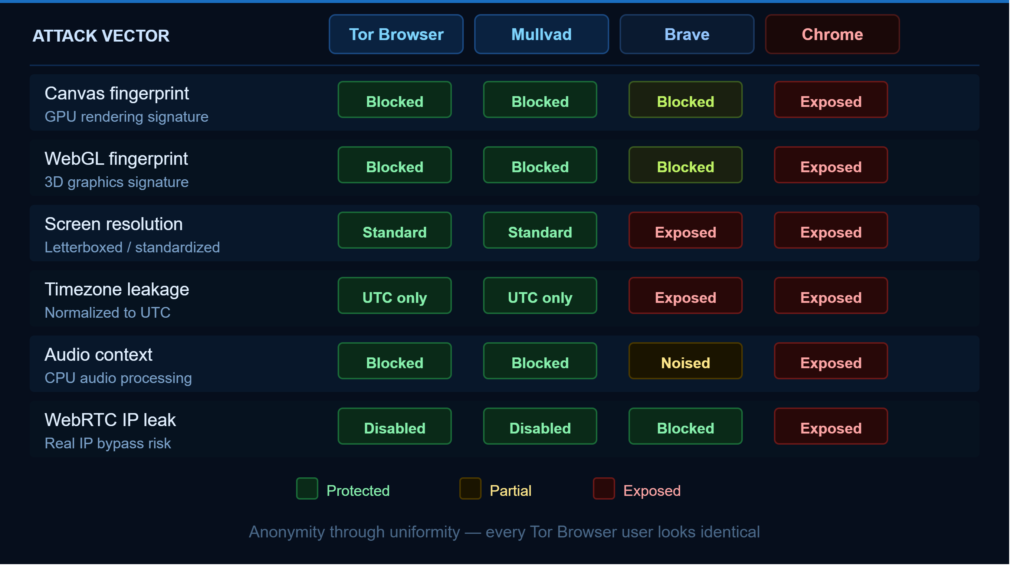
Tor Browser solves this by making every single user look exactly the same. The screen size is always the same. The fonts are always the same. The audio output looks the same. When all users look identical, no one can be picked out. Mullvad Browser uses the same approach. This is the real reason why you must not resize the Tor Browser window or install any add-ons. The moment you do either of those things, your browser starts to look different from everyone else, and the protection breaks.
| What Sites Can Track | Tor Browser | Mullvad Browser | Brave | Chrome |
|---|---|---|---|---|
| Screen rendering | Blocked | Blocked | Blocked | Exposed |
| 3D graphics | Blocked | Blocked | Blocked | Exposed |
| Screen size | Hidden | Hidden | Exposed | Exposed |
| Time zone | UTC only | UTC only | Exposed | Exposed |
| Audio output | Blocked | Blocked | Scrambled | Exposed |
| Real IP address | Blocked | Blocked | Blocked | Exposed |
| Installed fonts | Blocked | Blocked | Partial | Exposed |
Should You Use a VPN With Tor? The Honest Answer
Almost every guide about dark web browsers says you should always use a VPN together with Tor. That advice sounds safe, but it is not always correct. Sometimes it can actually make things worse. Here is why.
When you use a VPN before Tor, your traffic goes from you to the VPN, then to Tor, then to the website. Your internet provider can no longer see that you are using Tor because it only sees the VPN connection. This is useful if your internet provider monitors Tor use or if using Tor is illegal where you live. The problem is that you are now trusting the VPN company with that information instead of your internet provider. If the VPN company keeps records, it can be forced to hand those records over. You have not removed the risk. You have moved it to a different company.
For most people, using bridges instead of a VPN is a better choice. Bridges already hide the fact that you are using Tor from your internet provider. They do not cost money. They do not require trusting a third-party company. And they are harder to detect than a VPN connection.
Use a VPN with Tor only if bridges have not worked for your specific situation and you have checked that the VPN company genuinely does not keep any logs. Otherwise, bridges alone are the cleaner option.
How to stay ahead of the game? Check below. ⬇️


To be redirected to the official site, click here
The Attack Nobody Else Tells You About
Read also: How to Remove Location Information from Photos Before Sharing Them
Tor works by making sure no single computer ever knows both where you are and where you are going at the same time. The first computer in the chain knows your location but not your destination. The last computer knows your destination but not your location. That separation is what makes it private.
But there is a way around this that does not require breaking that system at all. If an attacker can watch your internet connection at home and also watch the traffic coming out of Tor toward the website you are visiting, they can compare the two streams. Your packets are still scrambled and unreadable, but the timing and size of your traffic create a pattern. If the pattern going in matches the pattern coming out, the attacker can conclude with high confidence that it is you, even without reading a single byte.
This is called a timing attack or traffic analysis attack. It requires enormous resources. It is only done by large government intelligence agencies against specific people they are already investigating. If you are at Level 1 through 3 on the threat scale above, this is not something you need to worry about. Tor provides more than enough protection. If you are at Level 4 or 5, combining Tor with Whonix or Qubes reduces the risk further by creating traffic patterns that are harder to match.
The Mistakes That Actually Get People Identified
In almost every documented case where someone using Tor was identified, the cause was not a flaw in Tor itself. It was something the person did. These are the most common mistakes.
- Making the browser window bigger or smaller. Tor hides your screen size by keeping the window at a fixed standard size. If you resize it, your real screen size becomes visible and makes you stand out.
- Signing into an account tied to your real name. Once you log into Gmail, Facebook, or any account with your name on it, that website knows who you are. It does not matter that you used Tor to get there. The login undoes all the anonymity.
- Opening downloaded files while still connected to Tor. Some file types, like PDFs and Word documents, can automatically connect to the internet when you open them. That connection bypasses Tor completely and uses your real internet connection, which reveals your real location. Download the file first. Disconnect from Tor. Then open it.
- Using the same username in two places. If you use a certain name in a dark web forum and also use the same name anywhere on the regular internet, that link can be found. Your writing style, the times you post, and the topics you discuss. All of these create patterns that can connect your anonymous identity to your real one.
- Adding any extensions to Tor Browser. Each extension changes how your browser behaves. That change makes you different from every other Tor Browser user. Means are identifiable differently.
- Forgetting about other apps on your computer. Tor Browser protects only the traffic that goes through it. Every other app on your computer, your email client, your cloud backup software, and system update tools keep connecting to the internet normally, using your real address. Tails and Whonix are the only tools that fully solve this problem.
Read also: Ultimate Carding Tutorial: Expert Guide to Carding
A Real Example: What to Do and What Not to Do
A Human Rights Researcher called Amara in a High-Risk Country
Amara documents human rights abuses for an international organization. She lives in a country where the government actively monitors internet traffic, blocks Tor, and has arrested people before based on their digital activity.
What Amara does wrong at first:
She downloads Tor Browser on her regular laptop. Her internet provider immediately sees the connection attempt to Tor’s public servers. She tries a bridge, but the government’s traffic inspection system sends test connections to the bridge address, confirms it is a Tor bridge, and blocks it within a day. A witness sends her an important document. She opens it in Microsoft Word while still connected to Tor. Word automatically reaches out to Microsoft’s servers to check for updates. That connection goes through her real internet connection, not Tor, and it reveals her real location.
What Amara should do instead:
Before she travels, she downloads Tails on a different network and checks the digital signature to confirm the file is genuine. She creates the USB drive using the official Tails installer.
When she needs to work, she plugs in the USB and boots the computer from it. Her normal operating system never loads. Inside Tails, she selects Snowflake as her connection method. Snowflake makes her Tor traffic look like video call traffic, which is very hard for governments to block without also blocking legitimate video calls.
When she receives documents, she saves them to her encrypted storage area inside Tails. She does not open them until she has shut down Tails completely and booted into a separate offline computer specifically for reviewing documents.
She uses an email address that ends in .onion, created only for this work and accessed only through Tails, never connected to her real name or her personal email.
She uses a cheap laptop she bought with cash just for this purpose. Her personal laptop is never used for this work.
If her laptop is ever seized, there is nothing on it. Tails never wrote anything to the hard drive. The USB is encrypted. Her real location was never sent over the network. This level of care matches the level of risk she faces.
Which Search Engines Work on the Dark Web
Regular search engines like Google do not list it. onion websites. You need different search tools to find things on the dark web.
- Ahmia at ahmia.fi: This is the cleanest option for research. It lists .onion sites but actively removes illegal content from its results. You can use it on the regular web or through Tor.
- DuckDuckGo: DuckDuckGo has a .onion address and does not track your searches. Use it through Tor for private searches of the regular web.
- Torch: One of the oldest dark web search engines. It indexes a lot of content without filtering much of it. Be aware that results include illegal content alongside legitimate sites.
- The Hidden Wiki: A directory of .onion links, not a search engine. Good as a starting point. Be careful: fake versions of The Hidden Wiki exist that lead to scam sites. Always check the address from multiple reliable sources before visiting.
Frequently Asked Questions
Is it legal to use a dark web browser in 2026?
In most countries, yes. Downloading and using Tor Browser, Tails, or Whonix is completely legal. These tools are used every day by journalists, lawyers, security researchers, and people who simply care about their privacy. What you do while using them is a separate question. Accessing or doing something illegal is still illegal regardless of which browser you used to get there. A small number of countries, including China and Russia, restrict or ban anonymizing tools. If you live in one of those countries, check the local laws before downloading anything.
Do I need to use a VPN with Tor?
For most people, no. A VPN can be useful in specific situations, like when your internet provider monitors Tor connections or when using Tor is illegal where you live. But for most users, using Tor bridges instead of a VPN is a simpler and often better choice. Bridges hide your Tor use from your internet provider without requiring you to trust a VPN company. If you do use a VPN, use one that genuinely keeps no logs and has been independently audited to confirm that.
What is the difference between the deep web and the dark web?
systems, and the deep web is any part of the internet that search engines do not list. Your email inbox, online banking, private company systems, and content you have to pay or log in to see. This is most of the internet, and it is entirely normal. The dark web is a much smaller, specific part of the internet that requires special software like Tor to access. It uses .onion addresses. Some of it is useful and legal. Some of it is not. The two terms are often mixed up, but they are very different things.
Can Tor protect me from viruses and malware?
No. Tor protects where your traffic comes from and where it goes. It does not scan files for viruses or block harmful software from running. If you download a file from a dark website and open it, any harmful software inside it will run on your computer just as it would if you had downloaded the file from anywhere else. If you need to open files from unknown sources, do it inside an isolated virtual machine or use a disposable session in Qubes OS.
How do I know if Tor Browser is actually working?
Visit check.torproject.org in Tor Browser right after you connect. The page will tell you clearly whether your traffic is going through Tor or not. Do not skip this step. The browser starting up does not guarantee that every part of the connection is working correctly. This check takes about ten seconds and confirms it properly.
What is the best setup for Android?
Use Orbot together with Tor Browser for Android. Tor Browser handles your dark web browsing. onion sites. Orbot covers all the other apps on your phone, routing their traffic through Tor as well. If Tor is blocked where you are, go into Orbot’s settings and enable bridges. Snowflake works well in most places with heavy restrictions. For the strongest possible setup, use a phone running GrapheneOS, which removes Google’s background data collection from Android.
Is Brave Browser safe enough for dark web use?
Use: For casual, low-risk use, it is fine. Opening a Tor window in Brave is easy and convenient for a quick visit to an onion site. But Brave’s Tor feature was built by Brave, not by the Tor Project. It does not offer the same level of fingerprint protection or the same careful default settings as the actual Tor Browser. If there is any real risk involved in what you are doing, use Tor Browser. If you are just curious and checking something out, Brave’s Tor window is acceptable.
Is Qubes OS too complicated for a regular person to use?
Honestly, yes for most people. Qubes OS has a steep learning curve. It also needs a computer with enough memory to run several virtual machines at the same time, and not every computer is compatible. It is genuinely worth the effort for people who face serious threats. But if you are a regular person who just wants better privacy, start with Tor Browser. If you need stronger protection than that, try Tails. Qubes is for situations where the stakes are extremely high and you have time to learn how to use it properly.
Can I use a regular browser on the dark web?
No, not for .onion sites. Chrome, Safari, and Edge cannot open. onion addresses at all. Firefox can be set up to work with Tor through its proxy settings, but this requires technical knowledge and additional configuration to be safe. It is missing many of the protections that Tor Browser adds on top of Firefox, for anyone who just wants to access. For onion sites, downloading the Tor Browser is the straightforward answer. It takes about two minutes and is free.
What happened to Subgraph OS?
Subgraph OS was a privacy-focused operating system that got a lot of attention around 2016 and 2017, partly because Edward Snowden mentioned it. It had Tor built in and used sandboxing to try to contain any harmful software. The problem is that it stopped being updated. Security software that is no longer updated becomes less safe over time as new threats appear and old problems are never fixed. If you were planning to use Subgraph, use Tails or Whonix instead. Both are actively maintained and do the same job better.
visit
Final Thoughts
Choosing the right browser is only one part of staying private online. It is an important part, but it is not the whole picture.
For most people, Tor Browser set to its highest security level is all they need. It is free, it works on Windows, Mac, Linux, and Android, and it has a proven track record. Start there.
If you need to use a computer and leave no trace behind, Tails is the answer. If you need to do ongoing private work over many sessions, Whonix gives you a setup where your real location simply cannot leak. If you face the most serious possible threats from a government or intelligence agency, Qubes OS with Whonix is the strongest realistic option for a private individual.
But here is the thing most people miss. In almost every real case where someone using Tor was identified, it was not because Tor failed. It was because the person did something that gave themselves away. Logged into a personal account. Opened a file while still connected. Used the same username in two places. Resized the browser window.
The browser cannot protect you from your own habits. Learn what the tool does and does not do. Follow the basic rules. And match the tool to the actual risk you face, not the highest risk you can imagine. That is the real guide to staying private online.
Read next: How Do Spam Callers Spoof Phone Numbers Step by Step?
Verified Carding Markets for Cashouts
Verified accounts, real logs, and secure transfers - browse the categories most buyers trust on clear and darkweb.
Leave a Reply